
How to Say ‘I Love You’ in British Sign Language: BSL, SSE and ASL Explained
BSL

Short answer: there is no universal “I love you” gesture used by every sign language. In British Sign Language (BSL), affection is expressed through signs chosen and arranged for the context. A literal I–LOVE–YOU sequence follows English word order and may instead be Sign Supported English (SSE), particularly when it accompanies speech.
BSL has its own grammar and is not English conveyed through hand movements. The most respectful practical answer is therefore to learn the form used by the BSL signer with whom you want to communicate.
Watch verified BSL signs
There does not appear to be a single UCL BSL SignBank entry prescribing the complete English phrase “I love you” as one fixed BSL construction. You can, however, watch its directly accessible BSL SignBank demonstration for LOVE. The entry presents moving examples and documented variants, which are more useful than written handshape instructions.
BSL SignBank also provides a direct search for YOU and related entries. Pronouns in a signed language depend on context and reference, so learners should watch the relevant video and read the entry information rather than treating an English label as a complete translation.
Important: these links demonstrate vocabulary, not a mandatory three-sign sentence. Ask the intended recipient which expression they use, or learn a natural contextual version from a fluent Deaf signer or suitably qualified BSL teacher.
How do you express “I love you” in BSL?
A natural expression depends on who is signing, the relationship, the conversational context and regional or personal language variation. BSL signs use coordinated handshape, movement, location, orientation, eye gaze, facial expression and body movement. Meaning is not carried by the hands alone.
The British Deaf Association’s information about the BSL Act describes BSL as an indigenous language of Great Britain with its own syntax and grammatical structure. The British Sign Language Act 2022 recognises BSL as a language of England, Wales and Scotland. These sources support an essential distinction: BSL is a language in its own right, not signed English.
Written labels such as I, LOVE and YOU are called glosses. They help people discuss signs in writing, but they do not capture movement, grammar or the full meaning of an utterance. Placing three English glosses in English order does not by itself make a natural BSL sentence.
BSL, SSE and ASL: what is the difference?
British Sign Language (BSL)
BSL is used within the UK’s Deaf community and has its own vocabulary and grammar. It makes meaningful use of the hands, face, head, body and signing space. Its structure should not be assumed to match spoken English.
BSL also varies by region, generation and community. BSL SignBank’s corpus-based dictionary records multiple variants for some concepts, including LOVE. Two fluent signers can therefore use different established forms without either being wrong.
Sign Supported English (SSE)
SSE uses signs in support of spoken English and generally retains English word order. It is a communication approach, not a separate natural language. Someone speaking “I love you” while adding signs for each English word may be using SSE rather than producing a natural BSL utterance.
This does not mean that every sequence containing those concepts is automatically incorrect. Language depends on context. It means that a word-for-word English sequence should not be advertised as the single definitive BSL translation.
American Sign Language (ASL)
The familiar one-handed “ILY” handshape belongs to ASL. It combines features of the ASL manual-alphabet letters I, L and Y. Although people elsewhere may recognise it through popular culture, it is not a universal sign and should not be presented as a native BSL equivalent.
BSL and ASL are distinct languages. Their manual alphabets differ too: BSL fingerspelling is normally two-handed, while ASL fingerspelling is one-handed. A sign shown in an American video, dictionary or app should not automatically be labelled BSL.
Why a still image cannot teach the complete sign
A photograph can illustrate a moment, but signs unfold through time. To understand and reproduce a sign accurately, watch these features in a moving specialist demonstration:
- Handshape: the arrangement of the fingers and thumb.
- Orientation: the direction in which the palm and fingers face.
- Location: where the sign occurs in relation to the body and signing space.
- Movement: its direction, path, repetition, size and speed.
- Non-manual features: relevant facial expression, mouth pattern, eye gaze, head movement and posture.
Changing one feature can change or obscure a sign. Left-handed signers also commonly mirror a demonstrated sign rather than forcing right-handed production. Follow the complete moving example and seek feedback instead of copying a frozen hand position.
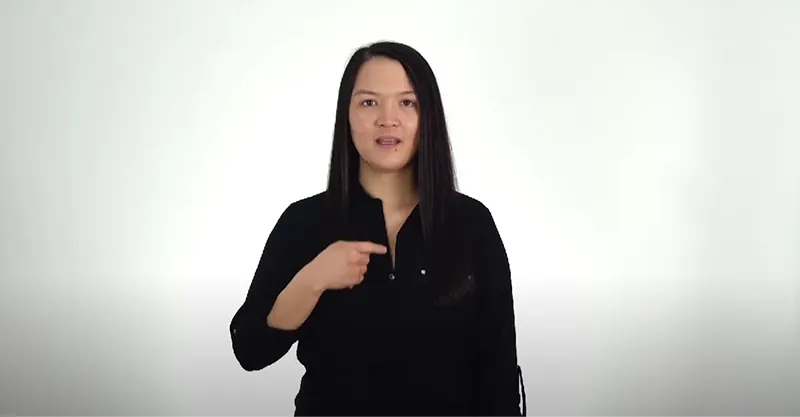
This photograph illustrates a point towards the signer. It cannot establish the meaning of a complete BSL expression without the surrounding movement, eye gaze and discourse context.
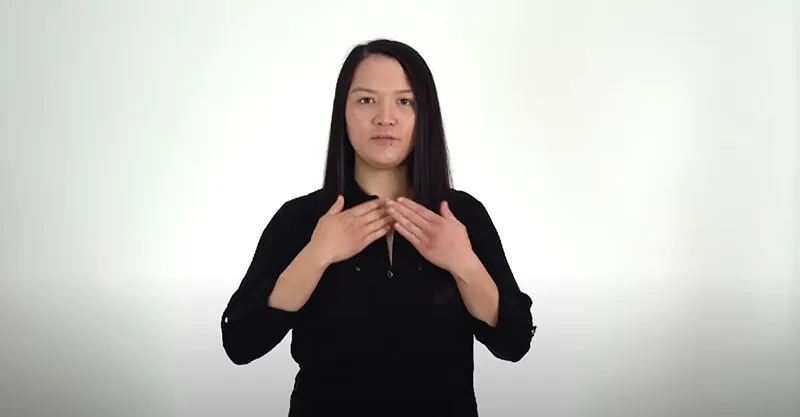
This still shows one moment near the chest but cannot communicate the sign’s movement or non-manual features. Use the linked BSL SignBank LOVE entry to watch documented moving forms.
 Are you ready to learn British Sign Language (BSL)?
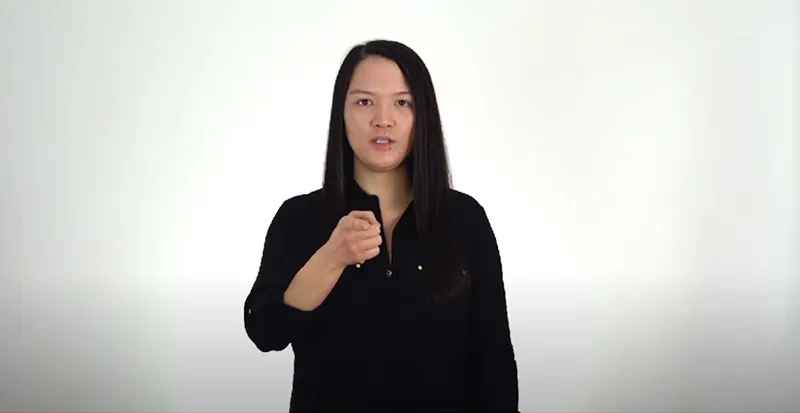
Pointing may identify a person or a location already established in signed discourse. Its function depends on context and cannot be diagnosed reliably from a photograph.
A practical way to learn the expression
- Ask which communication method the person prefers. Do not assume that every Deaf person uses BSL.
- Open the moving BSL demonstrations. Start with the directly linked LOVE entry and examine any variants provided.
- Watch, pause and replay. Observe movement and facial information as well as the hands.
- Check the context. Do not assemble dictionary entries as though BSL must follow English word order.
- Ask about personal or regional usage. The person you love may use a different recognised variant or phrase the sentiment differently.
- Practise with informed feedback. A fluent Deaf BSL user or suitably qualified BSL teacher can correct details that text and photographs cannot show.
A useful language-learning mechanism: form, meaning and context
When learning a sign, separate three questions. First, what is its physical form—including movement and non-manual features? Secondly, what range of meanings does the dictionary entry document? Thirdly, in which conversational context would a fluent signer choose it?
This mechanism helps prevent a common error: finding an English word in a dictionary and assuming it can be inserted into an English sentence unchanged. Dictionaries provide evidence about vocabulary, but natural communication also requires grammar, reference and shared context. That is why a moving entry plus feedback from a fluent signer is more dependable than a numbered set of hand-position instructions.
If someone close to you uses BSL, learning more than one isolated phrase can support richer communication. You may also find it useful to explore why British Sign Language is important.
Respectful communication with Deaf people
Sign language is not the only way Deaf people communicate. An individual may prefer BSL, spoken language, captions, written communication, lipreading, assistive technology, an interpreter or a combination. Ask rather than guess.
Gain the person’s attention respectfully before starting. Face them, keep your mouth visible if they use lipreading and avoid speaking only to a hearing companion. When an interpreter is present, address and engage with the Deaf person rather than treating the interpreter as the participant.
For healthcare, legal, workplace or public-service communication, a beginner should not replace an appropriately competent communication professional. Case-specific access requirements should be agreed with the Deaf person and the responsible service.
Choosing BSL learning resources
Look for moving examples that are clearly labelled as BSL and that acknowledge variation. UCL BSL SignBank is a specialist corpus and dictionary resource created from language data supplied by Deaf BSL users. For formal learning or assessment, check the course level, teacher’s relevant competence, learning outcomes and awarding arrangements.
Lead Academy offers commercial online BSL-related courses. That course promotion is separate from the independent BDA, legislation and UCL dictionary sources used to verify the language guidance on this page. Before enrolling in any course, confirm that its content, teaching approach and certificate meet your particular aim.
Top Courses of this Category

British Sign Language for Beginners – CPD Certified | Live Zoom Class
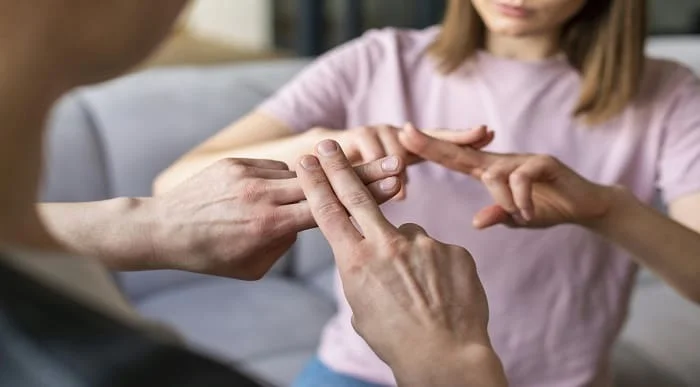
British Sign Language Level 1 & 2: Online BSL Course

BSL Training for Workplace – CPD Certified | Live Zoom Class [Business Customers Only]

Introduction to British Sign Language | CPD Certified – Live Zoom Class

Deaf Awareness Training Course Online
Frequently asked questions
Is there one universal sign for “I love you”?
No. Sign languages are distinct languages rather than one international system. BSL, ASL and other sign languages have different vocabulary and grammar, and individual languages can contain regional and social variation.
Is I–LOVE–YOU always BSL?
No. Signing three vocabulary items in English order, especially alongside spoken English, may be SSE. The labels alone do not reveal the grammar, movement or context of the complete utterance.
Can I use the ASL “ILY” handshape in Britain?
Some people may recognise it, but recognition does not make it a universal or native BSL construction. If you want to communicate with a BSL user, ask what they use and learn from a reliable BSL source.
Can anyone learn BSL?
Yes. Deaf, hard-of-hearing and hearing people can learn BSL. Isolated vocabulary is a starting point, while conversational ability also requires receptive skill, grammar, cultural knowledge, interaction and sustained practice.
How long does it take to learn BSL?
There is no single timescale. Learners can acquire introductions and everyday vocabulary before they can understand and produce extended conversation. Progress varies with teaching quality, regular practice and access to interaction and feedback. Read more about how long it takes to learn sign language.
What is the best way to check a BSL sign?
Use a recognised moving BSL dictionary or corpus, read the entry notes, compare documented variants and seek feedback from a fluent Deaf signer or suitably qualified BSL teacher. Avoid relying solely on static images, an English gloss or an unlabelled social-media clip.
Key point
To express “I love you” respectfully, first establish whether the person uses BSL and ask which expression they prefer. Watch the verified BSL SignBank LOVE demonstration rather than copying a still image. Do not assume that English word order is BSL grammar, and do not confuse the ASL “ILY” handshape with a universal sign.
What to Read Next:
- How to Find and Learn the BSL Sign for Horse
- How to Learn the BSL Sign for ‘New’
- Choosing the Right BSL Sign for “Stop”
- How to Sign ‘Home’ in British Sign Language (BSL)
- T in British Sign Language – Video & Image Included
- Life in Sign Language – Video & Image Included
- How to Express “Happy Christmas” in British Sign Language (BSL)